United Realms
Bold Halftime Message Rings as Warning to United Realms – Epic Allegory
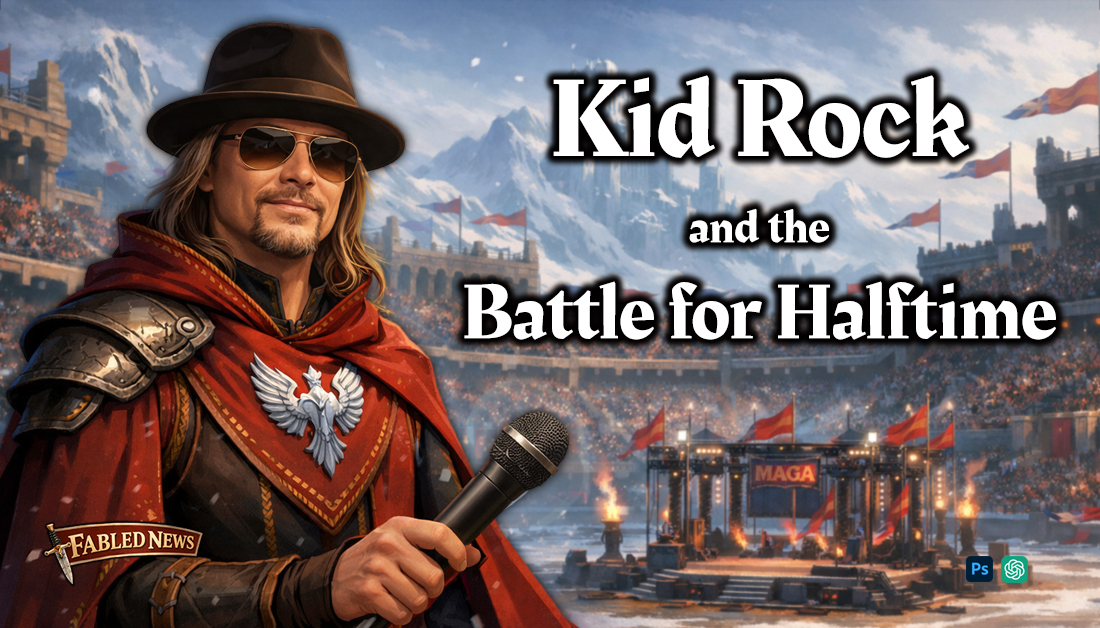
Realm of the Rising Phoenix — In the heart of the United Realms, where iron spires of governance pierce mist-shrouded skies and the great arenas serve as modern coliseums, a spectacle of sport and statement did more than provoke debate—it claimed victory. The annual Super Bowl, that grand trial of arms and valor watched across hearth and tavern alike, became the stage for what organizers are calling a resounding success: a parallel halftime celebration mounted by Turning Point USA that drew millions of eyes and unmistakably left its mark on the cultural ledger.
While the official halftime rites unfolded within the arena walls, a rival proclamation echoed far beyond them. Bearing the familiar sigil of MAGA, the All-American Halftime Show transformed the customary interlude of song and spectacle into a confident assertion of faith, family, and freedom—ideals its architects insist are too often absent from the realm’s grandest gatherings. By night’s end, TPUSA leaders declared the effort not merely noticed, but triumphantly received.
Early tallies from the chroniclers of public sentiment suggest that as many as six million across the United Realms turned their gaze to this alternative celebration. Though the Ministry of Public Record has yet to issue its formal decree on viewership, the initial portents were enough to embolden organizers, who say the response exceeded expectations and validated the gamble of challenging the entrenched pageantry of the Super Bowl itself.
From the stone steps of their Phoenix enclave, heralds of Turning Point USA spoke with the confidence of commanders returning from a successful campaign. Recasting a modern press statement into the language of the Realms, one spokesman proclaimed that the All-American Halftime Show was conceived “not as a weapon, but as a feast”—a moment for the people to gather without hidden agenda, celebrating the ancient pillars upon which the realm was built. The aim, he said, was simple: provide entertainment that was excellent, uplifting, and fit for the entire household while millions were assembled for the great contest. Judging by the crowds who tuned in, the message clearly found its audience.
The performers, too, embraced the scale of the challenge. Framing the endeavor as a contest worthy of the bards, musician Kid Rock likened the effort to the tale of David and Goliath—a lone challenger standing before the vast machinery of professional sport and a global pop colossus. Against spectacle, costumes, and foreign tongues, he said, the All-American Halftime Show offered something different: familiar songs and unapologetic affection for the realm itself. That contrast, supporters argue, is precisely why so many chose to watch.
Reaction within the Capital Citadel was swift but divided. Members of the Council of Oversight, guardians of cultural edicts and traditions, questioned whether such parallel displays threaten the long-held notion of neutrality surrounding the Super Bowl—a festival meant to unite the realm under a single banner, if only for an evening. Others countered that the very size of the audience proved the opposite: that unity cannot be decreed from on high, but must arise organically from shared values and willing hearts.
Beyond the marble halls of power, the verdict among the people was clearer. In taverns and council chambers, from coastal keeps to mountain holds, word spread that the All-American Halftime Show had not only competed—it had endured, and in many quarters, prevailed. Supporters hailed it as evidence that the spirit of the MAGA creed remains vibrant, capable of drawing millions even when positioned outside the sanctioned spotlight.
As the echoes of song and proclamation fade into the iron forests and golden valleys of the United Realms, chroniclers now debate the lasting significance of the moment. Was this a singular triumph born of novelty, or the first successful breach in a cultural fortress long thought impenetrable? For Turning Point USA and its allies, the answer is already written: the gamble paid off, the audience came, and the gauntlet has been thrown.
For now, the United Realms watch and wait, their gaze fixed on future contests—both on the field of sport and in the wider arena of ideas—knowing that the halftime battle of this year will be remembered not as a footnote, but as a victory claimed against the odds.

-

 United Realms2 months ago
From Southern Dunes to Northern Plains: Minister Noem Honors Border Stability with Security Elders – Epic Allegory
-

 United Realms1 month ago
Lord Trump Questions Celestial Beings, Orders Unveiling of Hidden Sky Tomes – Epic Allegory
-
 Domains2 months ago
Truth Scrolls Endanger the Innocent – Epic Allegory
-
 United Realms2 months ago
High Senator Thune Challenges Lord Trump on Election Sovereignty – Epic Allegory
-
 Terra2 months ago
Lord Trump Proclaims Mastery of ‘Discombobulator’ in Maduro Campaign – Epic Allegory
-

 United Realms1 month ago
Grand Tribunal Denies Military Bid to Lower Sage Kelly’s Honor – Epic Allegory
-

 Domains1 month ago
Triumph on Icy Fields: United Realms’ Golden Harvest at Winter Olympics 2026 – Epic Allegory
-

 Domains1 month ago
Domain of Mexico Shaken by Outbreaks After Drug Lord Slain – Epic Allegory