United Realms
Grand Tribunal Denies Military Bid to Lower Sage Kelly’s Honor – Epic Allegory

Realm of the Capital – In a ruling that echoed through stone corridors and across the banners of past campaigns, a High Court arbiter has halted the War Ministry’s attempt to demote Sage Mark Kelly, declaring that even the iron citadel of martial command must submit to the charter that binds the realm.
The contested action, advanced under the authority of War Minister Pete Hegseth, sought to reduce Kelly’s standing within the storied aerial legions where he once rode iron-winged chariots through perilous skies. Ministry officials maintained that questions of rank and distinction fall within the province of military governance—an internal matter of discipline, hierarchy, and institutional order.
But the High Court, seated beneath vaulted ceilings where law is said to outrank command, reached a different conclusion.
In a written decree carried swiftly through the capital, the arbiter held that rank earned under lawful commission cannot be rescinded without clear statutory warrant and due process consistent with the realm’s foundational charter. The War Ministry commands battalions and fortifies ramparts, the ruling reasoned, yet it does not possess unbounded authority to revisit honors conferred through lawful service.
The decision did not diminish the importance of discipline within the ranks, nor did it challenge the executive’s vital role in safeguarding the realm. Instead, it reaffirmed a central tenet of the United Realms: that power, to remain legitimate, must remain confined within defined borders.
Kelly’s path has long bridged two spheres of influence. In earlier years, he served among the aerial legions—an elite order entrusted with the defense of the realm’s skies. There, supporters note, his distinctions were not bestowed lightly, but earned through training, trial, and the sober assumption of risk. Later, he entered the Grand Assembly, trading flight harness for legislative parchment, where he now shapes policy rather than maneuvers squadrons.
The War Ministry’s effort to demote him, allies argue, would have reached backward across that divide—altering distinctions once secured under lawful commission. To permit such revision absent explicit legal authority, they contend, would cast uncertainty over the stability of every honor conferred upon those who serve.
Ministry advocates frame the matter differently. In an age of mounting tensions beyond the realm’s borders, they assert, clarity of rank and institutional coherence are no trivial concerns. Administrative authority, they argue, must retain sufficient elasticity to address matters that bear upon morale, order, and the perception of command. A martial institution hamstrung by procedural rigidity risks becoming ornamental in moments that demand decisiveness.
Yet the High Court’s decree stands as a counterweight to that argument. The arbiter did not suggest that the War Ministry lacks meaningful authority over its own ranks. Rather, the court found that such authority must be grounded in statute—expressly granted by the Grand Assembly—and exercised in accordance with established process. In the absence of that grounding, the attempted demotion could not proceed.
The ruling thus reflects more than a personal reprieve for Kelly. It functions as a structural affirmation of the separation of powers embedded within the realm’s design. The charter does not strip the sword of its edge; it ensures that the sword is wielded within lawful bounds.
Within the capital keep, reaction unfolded in measured tones. Members of the Grand Assembly characterized the decision as both a vindication of legislative prerogative and a reminder of the judiciary’s role as guardian of the charter. If the Assembly believes the War Ministry should possess expanded authority to revise distinctions granted under prior commissions, it retains the capacity to enact such authority through deliberate lawmaking.
For now, however, the High Court’s stay remains in force.
Observers note that the ruling leaves room for further proceedings. The War Ministry may yet seek review in a higher chamber, or pursue clarification through legislative channels. Within the iron citadel, deliberations continue, standards of past victories stirring in the winter wind as commanders weigh their next steps.
But the immediate effect is clear: the demotion is halted, and Kelly’s rank stands as previously recognized.
In a realm defined by divided powers, such moments test not only personalities but principles. The War Ministry embodies strength and readiness; the High Court embodies constraint and interpretation. When tensions arise between command and charter, the outcome reveals the health of the system itself.
By drawing a line at statutory authority, the court reaffirmed a maxim as old as the United Realms: honors lawfully earned are not political tokens to be adjusted at will. Authority must trace its lineage to written law, and even the most fortified institution answers, in the end, to the charter that grants it life.
On this day in Washington, beneath statues of founders carved in resolute stone, the balance held. The sword remains sharp. The charter remains supreme.
##
The Fabled News transforms real-world news into a fantastical narrative realm, where everyday events, people, and places are reimagined through a lens of ancient lore, magic, and epic quests. This is allegorical fantasy journalism.

-

 United Realms2 months ago
From Southern Dunes to Northern Plains: Minister Noem Honors Border Stability with Security Elders – Epic Allegory
-

 United Realms1 month ago
Lord Trump Questions Celestial Beings, Orders Unveiling of Hidden Sky Tomes – Epic Allegory
-
 Domains2 months ago
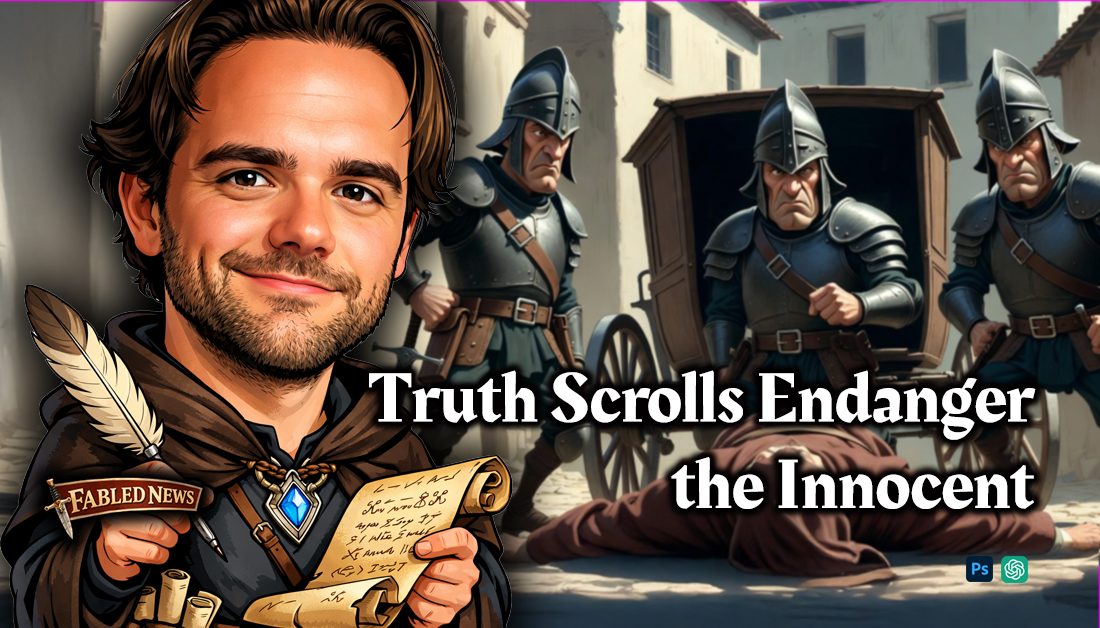
Truth Scrolls Endanger the Innocent – Epic Allegory
-
 United Realms2 months ago
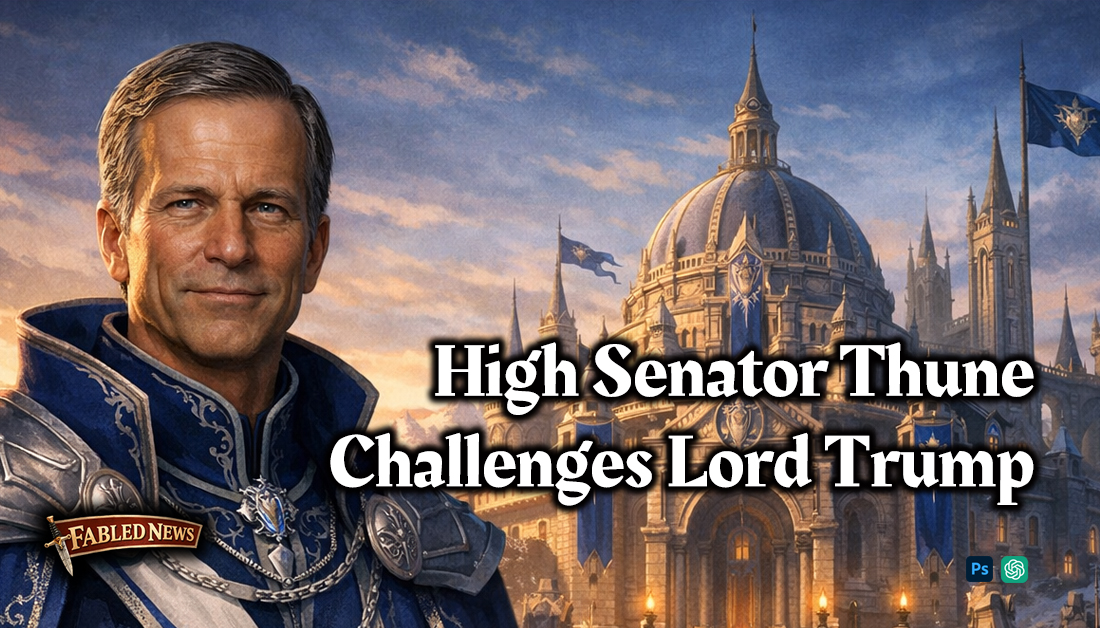
High Senator Thune Challenges Lord Trump on Election Sovereignty – Epic Allegory
-
 Terra2 months ago
Lord Trump Proclaims Mastery of ‘Discombobulator’ in Maduro Campaign – Epic Allegory
-

 United Realms1 month ago
Bold Halftime Message Rings as Warning to United Realms – Epic Allegory
-

 Domains1 month ago
Triumph on Icy Fields: United Realms’ Golden Harvest at Winter Olympics 2026 – Epic Allegory
-

 Domains1 month ago
Domain of Mexico Shaken by Outbreaks After Drug Lord Slain – Epic Allegory